
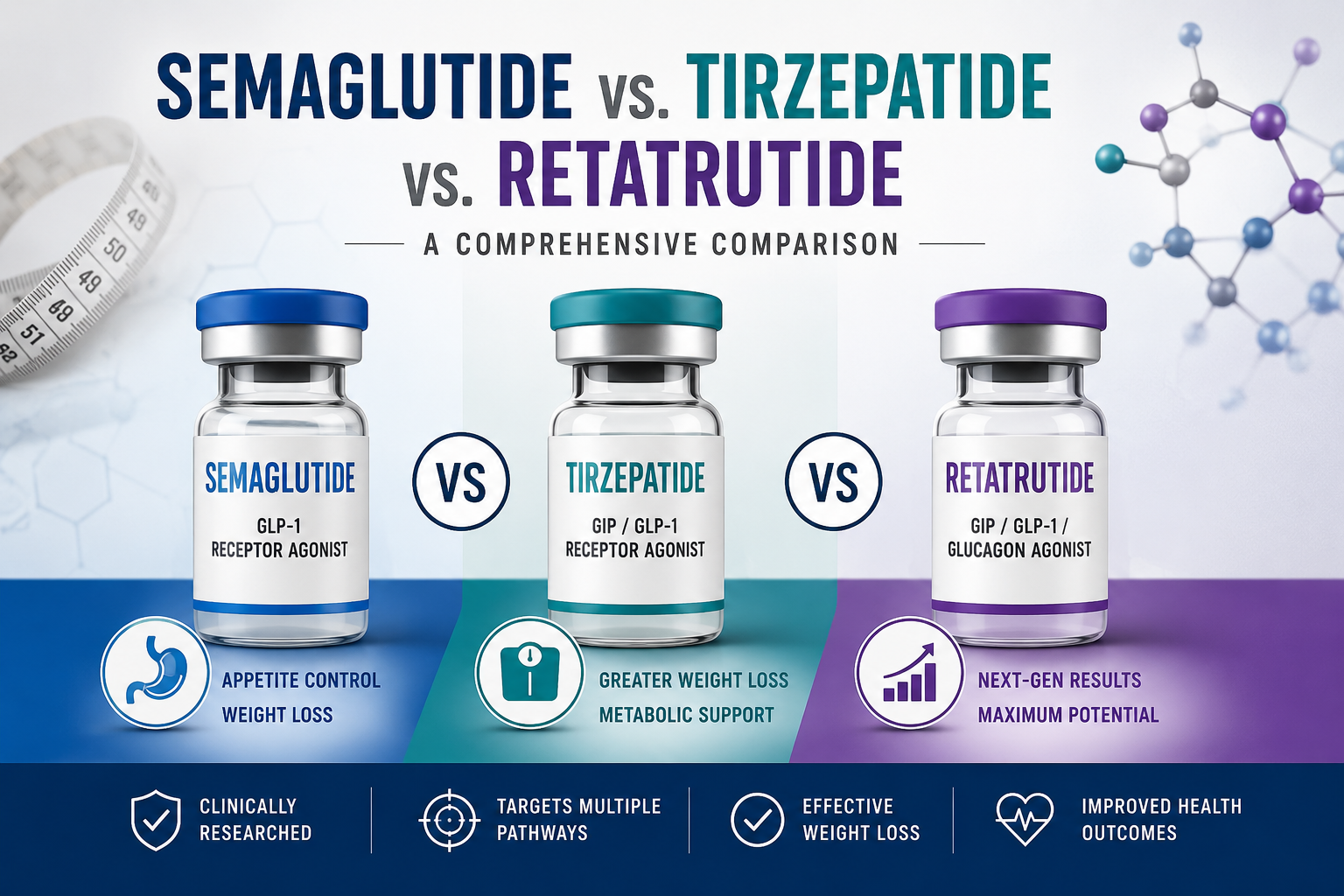
Two people can begin incretin-based weight-management treatment in the same month, follow similar nutrition guidance, and have different results. Medication selection is one factor, but dose escalation, tolerability, medical history, nutrition, activity, sleep, and long-term access also affect outcomes.
Semaglutide and tirzepatide are FDA-approved prescription medications with substantial evidence for chronic weight management in appropriate adults. Retatrutide now has positive Phase 3 topline results, but it remains investigational, is not FDA-approved, and is not available for routine prescribing or compounding.
Important Note: This article is educational and is not medical advice. Prescription treatment should be individualized after a qualified clinician reviews a patient’s medical history, medications, contraindications, and goals.
The Short Answer
For average weight loss, tirzepatide currently has an advantage over semaglutide 2.4 mg in the strongest published direct comparison. In the 72-week SURMOUNT-5 trial in adults with obesity or overweight plus a weight-related condition, tirzepatide produced a mean weight change of -20.2%, compared with -13.7% for semaglutide 2.4 mg.
That does not make tirzepatide the automatic choice for every patient. Semaglutide remains an effective evidence-based option, and Wegovy has an FDA-approved indication to reduce the risk of cardiovascular death, heart attack, and stroke in certain adults with established cardiovascular disease and overweight or obesity.
Retatrutide may become an important future option. Lilly has reported positive Phase 3 topline findings, including 25.0% mean weight loss at 80 weeks with the 12 mg dose in TRIUMPH-1. Those results have not yet been fully peer reviewed, and FDA has not approved retatrutide for any use.
What Each Medication Does
After eating, the gut releases hormones that influence appetite, gastric emptying, insulin secretion, and glucose control. These medications act on versions of those signaling pathways to support metabolic resetting and long-term health.
Semaglutide: A GLP-1 Receptor Agonist
Semaglutide activates the glucagon-like peptide-1 (GLP-1) receptor. It can reduce appetite, increase fullness, slow gastric emptying, and improve glucose-dependent insulin secretion. Semaglutide is sold under several brand names with different approved uses:
- Wegovy: Chronic weight management; selected cardiovascular-risk-reduction and other indications vary by product labeling.
- Wegovy HD: Higher-dose semaglutide injection approved in 2026 for weight reduction and long-term maintenance in eligible adults.
- Ozempic: Type 2 diabetes treatment.
- Rybelsus: Oral semaglutide for type 2 diabetes.
A brand name is not merely marketing. It determines the product, dose range, route, and FDA-approved indication.
Tirzepatide: A Dual GIP/GLP-1 Receptor Agonist
Tirzepatide activates both the glucose-dependent insulinotropic polypeptide (GIP) receptor and the GLP-1 receptor. It affects appetite and glucose regulation through overlapping but not identical pathways. Tirzepatide is sold as:
- Zepbound: Chronic weight management in eligible adults; it also has an FDA-approved indication for moderate-to-severe obstructive sleep apnea in adults with obesity.
- Mounjaro: Type 2 diabetes treatment.
The dual-receptor mechanism may contribute to tirzepatide’s greater average weight loss in trials. It is still too simplistic to say that GIP alone “burns fat” or fully explains an individual patient’s response.
Retatrutide: A Triple Agonist in Development
Retatrutide activates GIP, GLP-1, and glucagon receptors. Adding glucagon-receptor activity is intended to affect energy balance as well as appetite and glucose regulation.
Its early clinical data were notable. In a Phase 2 trial involving adults with obesity, the highest studied retatrutide dose was associated with a mean 24.2% weight reduction at 48 weeks. Since then, Lilly has released topline results from multiple Phase 3 studies. These data are promising, but they should be reported accurately: results announced by a drug manufacturer before complete peer-reviewed publication are not equivalent to an FDA approval or a settled safety profile.
As of August 2026, retatrutide is not FDA-approved. FDA states that it has not been found safe and effective for any condition and cannot be used in compounding under federal law. Patients should avoid products marketed online as “research use” retatrutide or purported compounded retatrutide.
The Evidence at a Glance
| Factor | Semaglutide | Tirzepatide | Retatrutide |
| Receptor activity | GLP-1 | GIP + GLP-1 | GIP + GLP-1 + glucagon |
| FDA-approved for obesity treatment? | Yes, as Wegovy | Yes, as Zepbound | No; investigational |
| Typical administration | Weekly injection; an oral Wegovy option is also available for eligible adults | Weekly injection | Studied as a weekly injection |
| Key efficacy evidence | Effective obesity treatment; semaglutide 2.4 mg was the comparator in SURMOUNT-5 | 20.2% mean loss at 72 weeks versus 13.7% with semaglutide 2.4 mg in SURMOUNT-5 | Positive Phase 3 topline data; no FDA-approved product available |
| Key strength | Mature evidence base and a cardiovascular-risk-reduction indication for eligible adults with established CVD | Strongest current approved head-to-head weight-loss evidence versus semaglutide 2.4 mg | Potential future option with large Phase 3 weight-loss effects reported |
| Key limitation | Some patients may lose less weight or have limiting GI effects | GI effects, access barriers, and individual tolerability remain important | Not approved; topline findings are not yet a complete peer-reviewed evidence base |
What Phase 3 Data Do We Have for Retatrutide?
Positive Phase 3 topline data are now available. The most important distinction for patients is that these are manufacturer-announced findings; full publications, regulatory review, labeling, and longer-term post-marketing data are still pending.
TRIUMPH-1: Obesity Without Diabetes
Lilly reported that the 80-week, placebo-controlled TRIUMPH-1 trial enrolled 2,339 adults with obesity or overweight without type 2 diabetes. At week 80, mean body-weight change was:
- -17.6% with retatrutide 4 mg
- -23.7% with retatrutide 9 mg
- -25.0% with retatrutide 12 mg
- -3.9% with placebo
In a pre-specified extension subgroup of 532 participants with baseline BMI of at least 35 who tolerated treatment and continued for 104 weeks, weight loss reached up to 30%. This extension result should not be generalized to every patient, since it reflects a selected subgroup rather than the full randomized study population.
TRIUMPH-2: Obesity or Overweight With Type 2 Diabetes
In the 80-week TRIUMPH-2 trial, Lilly reported mean weight changes of -12.7%, -19.1%, and -20.8% with retatrutide 4 mg, 9 mg, and 12 mg, respectively, versus -4.0% with placebo. The trial also reported A1C reductions of up to 1.6 percentage points in adults with type 2 diabetes and obesity or overweight.
TRIUMPH-3: Severe Obesity and Established Cardiovascular Disease
In TRIUMPH-3, which enrolled adults with BMI of at least 35 and established cardiovascular disease, Lilly reported mean weight loss up to -22.6% at 80 weeks with retatrutide 12 mg, versus -3.2% with placebo.
The trial was not designed or powered to prove a cardiovascular-outcomes benefit. The reported major adverse cardiovascular event estimates had wide confidence intervals, so the data should not be represented as proof that retatrutide reduces heart attacks, stroke, or cardiovascular death.
Important Safety Context
In the Phase 3 topline releases, gastrointestinal events—including nausea, diarrhea, constipation, vomiting, and decreased appetite—were common and were generally described as mild to moderate. Higher doses also had higher discontinuation rates due to adverse events in the reported trials. Dysesthesia and urinary tract infections were also reported more often in some retatrutide groups than with placebo.
The practical conclusion is not that retatrutide has “solved” obesity treatment. It is an investigational medicine with potentially substantial efficacy and a safety profile that still requires complete peer-reviewed reporting and FDA review.
Which Approved Medication Produces More Weight Loss?
The most useful comparison comes from a head-to-head study rather than placing different trials side by side. In SURMOUNT-5, tirzepatide resulted in greater average loss than semaglutide 2.4 mg over 72 weeks: 20.2% versus 13.7% of baseline body weight.
Those are averages, not guarantees. A patient’s experience can fall above or below an average because of:
- Dose and pace of titration
- Nausea, constipation, reflux, or other adverse effects that limit dose escalation
- Missed doses or medication interruptions
- Starting weight, diabetes status, and other metabolic conditions
- Protein intake, resistance training, sleep, and activity
- Medication affordability and long-term access
Semaglutide has also expanded beyond the original 2.4 mg weekly obesity dose. Wegovy HD, a 7.2 mg semaglutide injection, was approved by FDA in 2026 for eligible adults. Its trial program demonstrated greater average loss than earlier semaglutide dosing, but those findings should not be treated as a direct comparison with tirzepatide.
Side Effects and Safety Considerations
Semaglutide and tirzepatide share many common adverse effects:
- Nausea
- Vomiting
- Diarrhea
- Constipation
- Abdominal discomfort or indigestion
- Reduced appetite
Symptoms are often most noticeable during dose escalation. Slower titration, hydration, adequate meal planning, and communication with the prescribing clinician can improve tolerability for many patients. Persistent vomiting, dehydration, severe abdominal pain, or inability to maintain fluids warrants prompt medical attention.
Both approved drug families have important safety warnings and are not appropriate for every person. They carry boxed warnings regarding thyroid C-cell tumors observed in rodents and are contraindicated for people with a personal or family history of medullary thyroid carcinoma or multiple endocrine neoplasia syndrome type 2 (MEN2). A clinician should also assess history of pancreatitis, gallbladder disease, kidney disease, diabetic retinopathy, significant gastrointestinal disease, pregnancy plans, and current medications.
Do not describe either medication as universally “gentler.” Individual tolerability matters more than a simple class ranking.
Can You Switch from Semaglutide to Tirzepatide?
A switch may be considered when weight loss has plateaued despite adequate treatment exposure, adverse effects are difficult to manage, insurance changes, or a patient’s clinical goals change. It should be supervised by a prescribing clinician.
There is no patient-led dose-conversion formula. Semaglutide and tirzepatide have different approved dose-escalation schedules, and using an overly aggressive starting dose can increase gastrointestinal adverse effects. The clinician should determine timing, starting dose, follow-up, and whether other diabetes medications need adjustment.
Protecting Lean Mass During Weight Loss
Weight loss is not purely fat loss. During any substantial calorie deficit—including one created by effective appetite-reducing medication—some lean tissue can be lost along with fat mass. The amount varies by age, baseline muscle mass, protein intake, training status, total weight loss, and the method used to measure body composition.
The goal is to preserve strength, function, and as much lean tissue as reasonably possible. A sound program typically includes:
- Adequate protein and overall nutrient intake, individualized to health status and renal function
- Progressive resistance training when medically appropriate
- Regular physical activity and attention to mobility
- Tracking symptoms, strength, weight trajectory, and body composition when clinically useful
- Reassessment of the medication plan if intake becomes too low or function declines
Avoid claims that unapproved peptides, supplements, or routine hormone treatment will prevent muscle loss. Those interventions are not established substitutes for nutrition, resistance training, and appropriate clinical monitoring.
Cost, Coverage, and Compounded Products
Coverage is highly plan-specific. It can depend on the exact product, diagnosis, prior-authorization criteria, employer plan design, state Medicaid rules, and whether a patient has an FDA-labeled cardiovascular or sleep-apnea indication. A prior denial does not necessarily predict future coverage, but patients should verify their current formulary and prior-authorization requirements.
Compounded products require special caution. FDA-approved medications are reviewed for quality, safety, and effectiveness. Compounded products do not receive the same premarket FDA review, and pharmacies generally cannot routinely compound products that are essentially copies of commercially available FDA-approved medications. Availability and enforcement policy can change as shortages resolve.
Retatrutide is different: it is not FDA-approved and cannot lawfully be used in compounding under federal law.
Frequently Asked Questions
Is tirzepatide always better than semaglutide?
No. Tirzepatide produced greater average weight loss than semaglutide 2.4 mg in a direct clinical trial, but the right medication still depends on a patient’s medical history, adverse-effect tolerance, cardiovascular status, insurance coverage, access, and preferences.
How quickly do patients see results?
Some patients notice appetite changes within the first several weeks. Meaningful scale changes often become more apparent over 8 to 12 weeks as the medication is titrated. The safe and appropriate pace is individualized; faster is not always better.
Is retatrutide available by prescription or through a compounding pharmacy?
No. Retatrutide is investigational and is not FDA-approved. FDA states that it cannot be used in compounding under federal law. Products sold online as “research” retatrutide should not be treated as legitimate prescription medications.
Does retatrutide Phase 3 data mean it is safer or more effective than tirzepatide?
No. The Phase 3 topline results are encouraging but they are not a head-to-head trial against tirzepatide, and the complete data have not yet been fully peer reviewed. Cross-trial comparisons can mislead because study populations, dose-escalation schedules, endpoints, and follow-up differ.
Do these medications cause muscle loss?
They do not selectively target muscle, but substantial weight loss can include a reduction in lean tissue. Adequate nutrition, protein intake, resistance training when appropriate, and monitoring of function and body composition can help protect lean mass.
Can someone take these medications without diabetes?
Yes, when they meet the FDA-labeled criteria for chronic weight management. Eligibility generally involves obesity, or overweight plus a qualifying weight-related health condition. A clinician must determine whether a specific product is appropriate.
What happens after stopping treatment?
Appetite and weight can increase after medication discontinuation. For many people, obesity treatment is long-term care rather than a brief course. A clinician can help develop a maintenance strategy, whether that includes continued medication, a different medication, nutrition support, physical activity, or another plan.
Do I need extensive laboratory testing before treatment?
There is no one-size-fits-all lab panel. A clinician commonly reviews medical history, current medications, glycemic status, renal and hepatic considerations, and other risk factors. Additional testing—including hormone testing—should be based on symptoms, history, and clinical indication rather than used automatically for every patient.
The Bottom Line & Next Steps
Tirzepatide holds the strongest current direct evidence for greater average weight loss than semaglutide 2.4 mg. Semaglutide remains a highly effective medication with important cardiovascular evidence and may be the better clinical fit for some patients. Wegovy HD adds a higher-dose semaglutide option, but it should not be represented as directly equivalent to tirzepatide without head-to-head evidence.
Retatrutide now has compelling Phase 3 topline results, including 25.0% mean weight loss at 80 weeks with 12 mg in TRIUMPH-1. It is still investigational, not FDA-approved, not a lawful compounded option, and not yet supported by a complete peer-reviewed Phase 3 evidence base.
The best medication is not simply the one associated with the largest trial average. It is the FDA-approved therapy that fits the patient’s diagnosis, medical history, risks, access, goals, and capacity for long-term treatment.
Ready to Optimize Your Metabolic Health?
At Thrive Wellness Institute, our clinical team takes a comprehensive, individualized approach to medical weight management, metabolic flexibility, and cellular longevity. We look beyond standard metrics to evaluate your unique metabolic and hormonal landscape, ensuring your treatment protocol is safely tailored to your body and long-term health goals.
Schedule a consultation with our team today to explore which evidence-based protocol aligns with your clinical history and personal objectives.