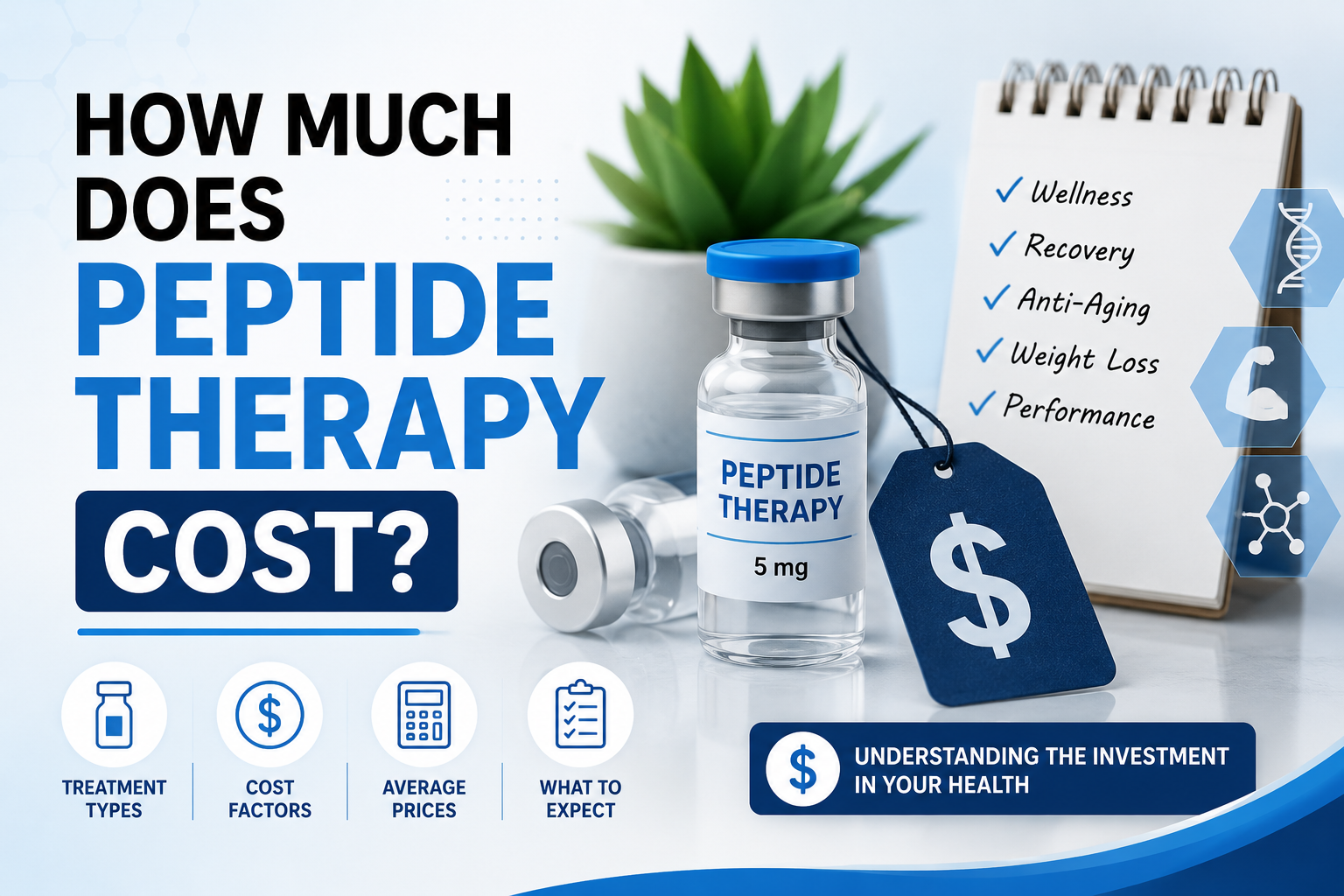
How much peptide therapy costs in 2026 depends less on the peptides themselves and more on how care is delivered. At Thrive Wellness Institute, we take a different approach: transparent pricing, physician-guided protocols, and a concierge model designed around patient outcomes rather than upsells.
Therapy Pricing: What the Market Looks Like in 2026
Peptide therapy pricing remains highly variable across the market:
- Budget telehealth: $40 to $150 per month
- Mid-tier clinics: $200 to $600 per month
- Premium clinics: $600 to $1,500+ per month
Most patients ultimately spend between $250 and $600 per month when factoring in labs, consults, and supplies. What many do not realize is that 60 to 80 percent of that cost is not the peptide itself — it is the surrounding medical infrastructure: fragmented visits, bundled program fees, and layered overhead. This creates a system where patients often pay separately for consultations, lab work, follow-ups, and prescriptions, making long-term costs difficult to predict.
A Smarter Model: Thrive Wellness Annual Membership
Thrive Wellness Institute was built to eliminate that fragmentation. Our concierge peptide membership is a comprehensive, year-long care model designed for patients who want structured, medically guided optimization without unpredictable costs.
What Is Included in the $3,000 Annual Membership?
- Initial consultation (a $150 value applied toward membership)
- Comprehensive baseline and follow-up laboratory testing
- Unlimited peptide-related consultations throughout the year
- Personalized protocol design based on patient goals
- Ongoing monitoring, dose adjustments, and clinical oversight
Patients only pay separately for the peptides they choose to use, giving them full control over their treatment intensity and cost.
Why This Model Works Better Than Traditional Clinics
Traditional clinics often create barriers to continuity: every question, lab, or adjustment can trigger additional charges. That leads patients to either underutilize care or disengage altogether. The Thrive model removes those friction points:
- No per-visit fees means patients can ask questions early instead of waiting
- Lab monitoring is built in, improving safety and outcomes
- Protocols can evolve as goals change (weight loss, muscle gain, recovery, longevity)
- Long-term relationships replace transactional care
This is particularly important for peptide therapy, where titration, response monitoring, and adjustments are key to success.
What Patients Actually Pay with Thrive
With Thrive’s model, your total annual cost for peptide therapy becomes predictable:
- Membership: $3,000 per year
- Peptides: typically $50 to $400 per month depending on protocol
For many patients, this results in comparable or lower total yearly costs than traditional clinics, but with significantly higher access to care and clinical oversight.
Real Cost Example
A patient using a moderate protocol at $200 per month in peptides:
- Peptides annually: $2,400
- Membership: $3,000
- Total: $5,400 per year
In many traditional settings, similar care with consults, labs, and follow-ups can exceed this — often with less accessibility and less proactive dose management.
Safer Access: Changes in Peptide Regulation in 2026
As of 2026, increased FDA oversight and changes in compounding rules have shifted several peptides into more tightly regulated categories, with heightened expectations for documentation and safety. This means:
- Greater scrutiny on sourcing and compounding practices
- Improved safety and consistency in peptide formulations
- Reduced availability of unregulated or gray-market products
At Thrive Wellness Institute, all peptides are sourced through reputable, regulated compounding pharmacies that meet current safety standards. This ensures patients receive pharmaceutical-grade products with verified quality, rather than research-only or gray-market options.
Who Benefits Most from a Peptide Therapy Membership?
This approach is ideal for patients who want:
- Structured weight loss programs (including GLP-1-based and peptide-based strategies)
- Body composition optimization and muscle development
- Injury recovery and performance support
- Skin health and anti-aging strategies
- Long-term longevity and metabolic health planning
Rather than short-term, isolated treatments, the focus shifts to continuous optimization guided by data and clinical expertise.
Peptide Therapy Cost FAQ for 2026
Q1. Is the $3,000 membership fee all-inclusive?
The annual membership covers your initial consultation, all peptide-related follow-up visits, baseline and follow-up labs, protocol design, and ongoing clinical oversight. You only pay separately for the specific peptides you decide to use.
Q2. How much should I expect to spend on peptides each month?
Most patients invest between $50 and $400 per month on peptides, depending on the number of peptides in their protocol, dosing, and treatment goals. A focused, single-goal plan usually stays on the lower end of that range.
Q3. How does the total yearly cost compare to a traditional clinic?
In traditional models, when you add up consults, labs, follow-ups, and prescriptions, annual costs can easily meet or exceed what patients pay at Thrive often with less access and fewer touchpoints.
Q4. Are labs really included, or will I get surprise bills later?
Baseline and follow-up labs that are part of your peptide program are included in the membership. If any testing outside the agreed-upon protocol is recommended, it is discussed in advance so you can make an informed decision.
Q5. What happens if my goals change during the year?
Your membership is designed to flex with your goals. If you start with weight loss and later shift toward performance, recovery, or longevity, protocol design and follow-up visits are already covered no additional visit fees are added.
Q6. Can I pause my membership if I stop peptides?
The membership is structured as a year-long care relationship and is not typically paused. However, you can scale your peptide use up or down at any time, which changes your monthly peptide spend while preserving full access to your clinical team.
Q7. Is this model right if I just want to try peptides briefly?
The membership is best suited for patients who see peptide therapy as part of a longer-term optimization strategy, usually at least 6 to 12 months. If you are looking only for a short trial, a traditional a la carte model may appear cheaper initially, but it often comes with less comprehensive monitoring and fewer opportunities to titrate effectively.
Q8. Does insurance cover peptide therapy in 2026?
Most insurance plans do not cover peptide therapy for optimization, longevity, or performance. The Thrive membership is a self-pay model designed to make out-of-pocket costs predictable and to consolidate services you would otherwise be paying for separately.
Q9. Why not just use a low-cost telehealth service?
Budget telehealth can be appropriate for simple, short-term use, but it often lacks the depth of lab monitoring, titration, and follow-up that peptides require for safe, effective long-term use. Thrive’s model is built for patients who value continuity, safety, and tailored protocols over the lowest possible monthly price.
Q10. How do I know if the membership is right for me?
If you want structured guidance, clear pricing, and easy access to a clinical team as you adjust and refine your peptide therapy over time, the membership model typically offers better value than paying for each touchpoint separately.