
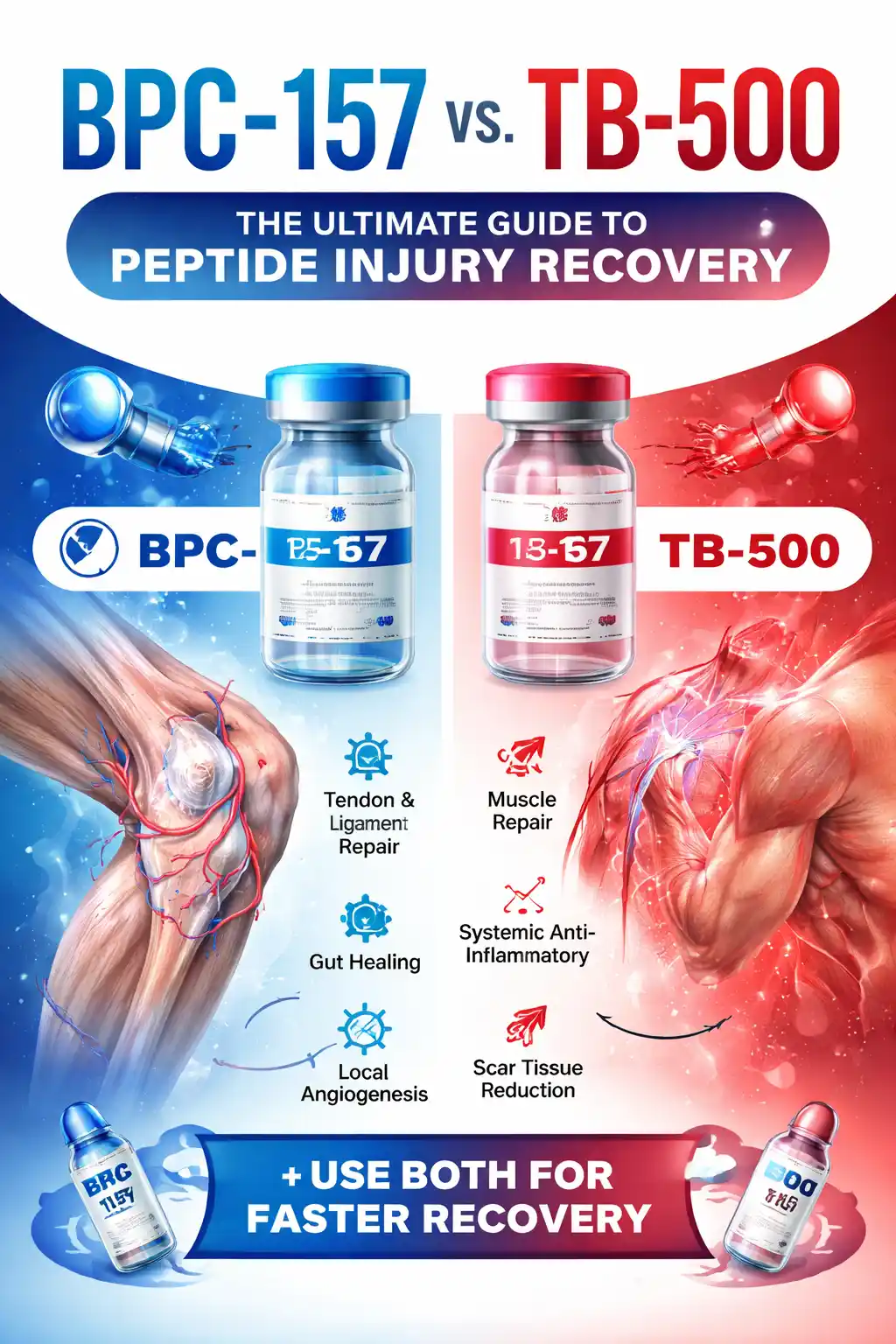
When conventional recovery methodsrest, ice, and basic physical therapyreach their limit, BPC-157 and TB-500 are often utilized as precision tools to accelerate tissue repair. While they are frequently “stacked” together, they operate through distinct molecular pathways. Choosing the right peptide, or the correct combination, requires an understanding of how they function at a cellular level
1. BPC-157: The “Infrastructure” Builder
BPC-157 (Body Protection Compound 157) is a pentadecapeptide derived from a protective protein naturally found in human gastric juice ($Gly-Glu-Pro-Pro-Pro-Gly-Lys-Pro-Ala-Asp-Asp-Ala-Gly-Leu-Val$). Its primary role is to build the biological infrastructure required for healing.
Molecular Mechanisms & Research
- Angiogenesis via VEGFR2: BPC-157 upregulates VEGFR2 (Vascular Endothelial Growth Factor Receptor 2) expression. Research indicates it installs more “antennas” on cells to catch existing repair signals, allowing for the formation of new blood vessels in hypovascular tissues like tendons.
- FAK-Paxillin Pathway: It activates the focal adhesion kinase (FAK) pathway, which is essential for cell migration and attachment, allowing repair cells to anchor to the site of damage and begin rebuilding.
- Human Clinical Data (2024–2025): While much of the early data was preclinical, a 2025 systematic review in HSS Journal analyzed its emerging use in sports medicine. Additionally, a 2025 retrospective study on chronic knee pain showed that 14 out of 16 patients reported significant relief lasting 6–12 months, and a 2024 pilot study on interstitial cystitis achieved symptom resolution in 10 out of 12 subjects.
2. TB-500: The “Workforce” Mobilizer
TB-500 is a synthetic version of Thymosin Beta-4 (T$\beta$4), a 43-amino-acid protein found in nearly every human cell. While BPC builds the “roads” (blood vessels), TB-500 recruits and directs the “workers.”
Molecular Mechanisms & Research
- Actin Regulation: TB-500 acts as a G-actin sequestering protein. By binding to actin monomers, it creates a “reserve” of cellular building blocks that are rapidly deployed to help cells move into a damaged area to begin reconstruction.
- Anti-Fibrotic Signaling: Through the release of the Ac-SDKP fragment during metabolism, TB-500 provides powerful anti-inflammatory and anti-fibrotic effects. This is crucial for ensuring that muscle and cardiac tissue heal with flexibility rather than stiff, non-functional scar tissue.
- Human Safety Trials: TB-500 has undergone multiple Phase I and Phase II trials. Research published by Ruff et al. (2010) and Wang et al. (2021) demonstrated that escalating doses were well-tolerated in humans with no dose-limiting toxicities. It has also shown success in Phase II trials for ophthalmic repair and dry eye.
Choosing the Right Peptide
The following table highlights how the specific mechanisms and research of each peptide impact the clinical choice.
| Factor | BPC-157 | TB-500 |
| Mechanism | Local Angiogenesis: Building new blood vessels and upregulating GH receptors in localized tissue. | Systemic Migration: Regulating actin for cell movement and reducing scar tissue (fibrosis). |
| Best For | Tendons, ligaments, and gut-specific structural repair. | Larger muscle groups, cardiac tissue, and post-surgical systemic support. |
| Injection Site | Localized: Most effective when injected near the injury due to its short half-life (< 30 min). | Systemic: Can be injected anywhere subcutaneously; travels freely through the body. |
| Anti-Inflammatory | Local: Targets the site of injury directly. | Systemic: Broad-spectrum reduction of cytokines via the Ac-SDKP pathway. |
| Research Depth | Moderate: High preclinical volume; emerging human pilot studies (2024-2025). | Moderate: Extensive preclinical data; multiple human Phase I & II safety trials. |
| Flexibility | Indirect: Improved through the repair of structural defects (tendons/ligaments). | Direct: Actively prevents adhesions and myofibroblast-driven stiffness. |
| Gut Benefits | Yes: Uniquely stable in gastric juice; heals the GI epithelium. | No: Degraded in the stomach; requires injection. |
Decision Guide: Practical Application
Choose BPC-157 if:
- You have a specific tendon injury (Achilles, rotator cuff, patellar).
- You are dealing with a ligament sprain (ACL, MCL, ankle).
- The injury is clearly localized to one specific area.
- You have gut issues affecting your overall recovery and nutrient absorption.
- You want faster, targeted repair at a specific localized site.
Choose TB-500 if:
- You have a muscle strain or tear, especially in larger muscle groups (hamstrings, quads).
- You are recovering from surgery and need broad, systemic support.
- Inflammation is widespread rather than localized to a single joint.
- You have cardiovascular tissue concerns.
- You need to improve range of motion and prevent the buildup of restrictive scar tissue.
Choose BOTH if:
- You are a serious athlete who needs accelerated, comprehensive recovery.
- You have complex injuries involving both tendons and surrounding muscle tissue.
- You are working with a practitioner to cover both the infrastructure and workforce pathways simultaneously.
The Case for Using Both Together
The “BPC-157 vs. TB-500” debate is often a false choice. Many experienced clinicians prefer to stack them because they address injury from two different angles.
BPC-157 acts as your precision tool, focusing on the blood supply and receptor sensitivity at the site of the tear. TB-500 acts as your broad-spectrum support, managing systemic inflammation and preventing the injury site from becoming stiff and non-functional due to scar tissue. A common analogy used in sports medicine: using only one is like fixing a roof leak from the inside without addressing the structural water damage on the ceiling. You need both to ensure a complete and functional recovery.
Common Questions & Regulatory Update
Do these peptides require a prescription?
Yes. This is the most critical area of change for practitioners and patients in 2026.
For several years, these peptides existed in a “regulatory gray area” after being moved to Category 2 by the FDA. However, as of April 16, 2026, the FDA and HHS officially reclassified BPC-157 and TB-500 as Category 1 Bulk Drug Substances.
- What this means: These peptides are no longer considered “research-only” chemicals in a legal vacuum.
- Compounding: Licensed compounding pharmacies are now legally permitted to prepare these peptides for patients, provided there is a valid prescription from a licensed physician or Physician Assistant.
- Safety: This reclassification acknowledges the safety data presented in recent years and ensures that patients can access these tools through regulated, high-quality pharmaceutical channels rather than unregulated sources.
Are there any contraindications?
Because both peptides promote angiogenesis (new blood vessel growth), they are strictly contraindicated for anyone with an active malignancy or a history of cancer. While they do not cause cancer, their mechanism could theoretically support the blood supply to a tumor. Always consult with your oncologist if you have a history of malignancy before starting a peptide protocol.
FAQs
1. What is the main difference between BPC-157 and TB-500?
BPC-157 focuses on localized healing and tissue repair, especially tendons and ligaments, while TB-500 works systemically, promoting cell migration and reducing inflammation across the body.
2. Can BPC-157 and TB-500 be used together?
Yes, many practitioners recommend stacking them for comprehensive recovery, as they support healing through different biological pathways.
3. Which peptide is better for muscle injuries?
TB-500 is generally better for muscle strains and large muscle groups due to its systemic action and ability to enhance cell movement.
4. Is BPC-157 effective for gut health?
Yes, BPC-157 is unique because it supports gut lining repair and improves digestive healing.
5. Are these peptides safe to use?
Recent clinical data suggests they are well-tolerated, but they should only be used under medical supervision.
Conclusion
BPC-157 and TB-500 are not competing solutions—they are complementary tools in advanced injury recovery. BPC-157 strengthens the foundation by repairing damaged tissues and improving blood flow at the injury site, while TB-500 enhances recovery on a broader scale by mobilizing repair cells and reducing inflammation.
For localized injuries, BPC-157 may be sufficient. For systemic recovery or post-surgical healing, TB-500 offers broader benefits. However, combining both peptides often provides the most complete and efficient healing strategy, especially for athletes or individuals dealing with complex injuries.
As of 2026, with improved regulatory clarity and access through licensed providers, these peptides are becoming more structured, safer, and clinically accessiblebut should always be used under professional guidance.