
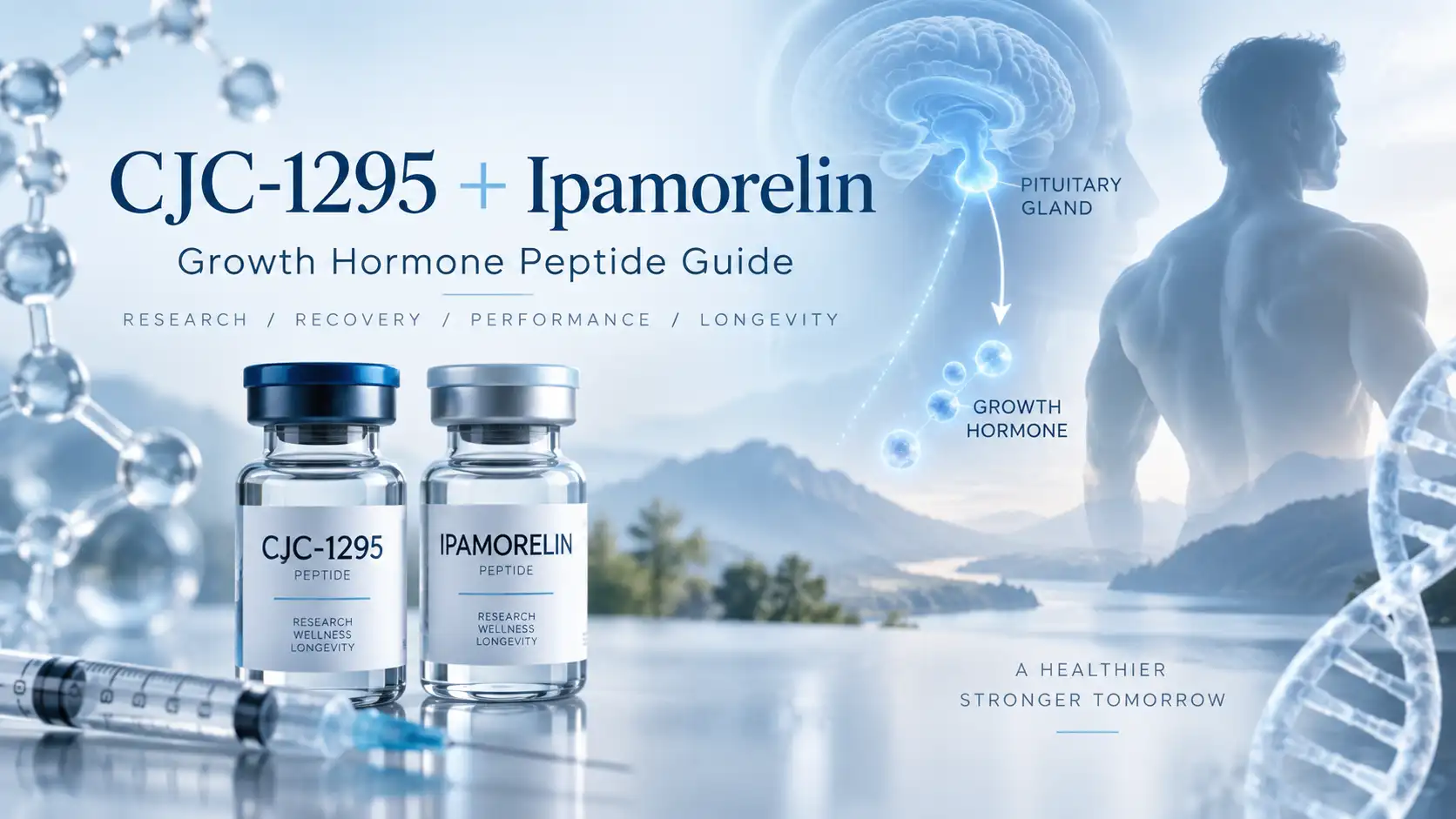
If you’ve spent any time in longevity or biohacking circles lately, you’ve probably heard two peptide names come up together more than almost any others: CJC-1295 and Ipamorelin. They’re consistently described as the “starter stack” for growth hormone optimization, and for good reason. Used together, they’re designed to work on two different biological switches that both lead to the same outcome: more of your own growth hormone, released the way your body naturally releases it.
This guide breaks down what each peptide actually does, why they’re paired together, what the evidence says, and where the current regulatory status stands, since that’s changed more than once in the past few years.
What Is CJC-1295?
CJC-1295 is a synthetic analog of growth hormone-releasing hormone (GHRH). It binds to GHRH receptors on the pituitary gland and tells it to release growth hormone, essentially amplifying a signal your body already sends naturally.
There are two versions worth knowing apart:
CJC-1295 Without DAC
CJC-1295 without DAC (often referenced as Mod GRF 1-29) has a short half-life of roughly 30 minutes to 2 hours, producing a GH pulse that mimics the body’s natural release pattern.
CJC-1295 With DAC
CJC-1295 with DAC is modified to last 6 to 8 days, producing a sustained elevation rather than a pulse.
For combination protocols with Ipamorelin, the no-DAC version is the one typically used, since its short half-life lines up with Ipamorelin’s roughly 2-hour half-life, preserving a more natural, pulsatile pattern of GH release rather than keeping levels constantly elevated.
What Is Ipamorelin?
Ipamorelin is a growth hormone secretagogue that works through an entirely different pathway. Instead of the GHRH receptor, it activates the ghrelin receptor (GHSR-1a), which triggers a more immediate release of growth hormone already stored in the pituitary.
Ipamorelin is generally considered the most selective peptide in its class. Unlike older secretagogues, it doesn’t meaningfully raise cortisol, prolactin, or appetite hormones at typical research doses, which is a large part of why it’s favored over older compounds like GHRP-6.
Why Combine CJC-1295 and Ipamorelin?
CJC-1295 builds the signal. Ipamorelin triggers the release. Put another way: CJC-1295 primes the pituitary to produce more growth hormone, while Ipamorelin tells it to release what’s available, right now, through a completely separate receptor system.
Because the two peptides act on different receptors on the same pituitary cell, their combined effect is described in the research as synergistic rather than simply additive.
Preclinical models have shown GH pulse amplitudes several times higher when the two are used together compared to either compound alone. That’s the entire rationale behind stacking them rather than using just one.
What Does the Research Actually Show?
This is where it’s worth being precise, because a lot of marketing around this stack blurs the line between what’s proven and what’s plausible.
What Is Well Established?
Each peptide has been studied individually in human trials.
Early CJC-1295 research found that even small weekly doses produced sustained, dose-dependent increases in growth hormone and IGF-1 levels in healthy adults.
Separate human trials on Ipamorelin found it reliably triggers growth hormone secretion at biologically meaningful levels, with peak concentration arriving within about an hour of administration.
What Has Not Yet Been Established?
No published randomized controlled trial has tested the specific CJC-1295 (no DAC) + Ipamorelin combination in humans at the doses commonly used in clinical and research settings today.
The case for the combination rests on strong individual pharmacology and cellular/animal evidence that the two receptor pathways are complementary, not on a completed human trial of the stack itself.
That distinction matters. The science behind why this combination should work is solid. Direct clinical proof that the combination outperforms either peptide alone in humans is still catching up.
What Is the CJC-1295 and Ipamorelin Combo Typically Used to Support?
Within the growth hormone optimization space, this stack is most commonly discussed in connection with:
Recovery and Sleep Quality
Recovery and sleep quality, since a meaningful share of GH release naturally occurs during deep sleep.
Lean Muscle Support
Lean muscle support alongside resistance training.
Body Composition Changes
Body composition changes over time, generally framed in months rather than weeks.
Metabolic and Anti-Aging Goals
General metabolic and anti-aging goals tied to healthier GH/IGF-1 levels.
It’s worth being direct about something the supplement side of this industry often isn’t: this combination is not a substitute for training, sleep, and nutrition. It’s studied as a support for the systems that respond to those inputs, not a replacement for them.
CJC-1295 vs. Ipamorelin: A Comparison
| Factor | CJC-1295 (No DAC) | Ipamorelin |
|---|---|---|
| Receptor pathway | GHRH receptor | Ghrelin receptor (GHSR-1a) |
| Mechanism | Amplifies GH signal from the pituitary | Triggers immediate GH release |
| Half-life | ~30 min – 2 hours | ~2 hours |
| Selectivity | GH-specific | Highly selective; minimal cortisol/prolactin/appetite impact |
| Typical role in the stack | Builds the signal | Releases the hormone |
| Used alone vs. combined | Effective alone, smaller pulse | Effective alone, smaller pulse; synergistic when combined |
Current FDA and Regulatory Status
This is the part of the conversation that changes the fastest, so treat any specific date-stamped claim as something to verify before acting on it.
In late 2023, the FDA placed both CJC-1295 and Ipamorelin on its Category 2 bulk drug substances list under Section 503A, which restricted licensed compounding pharmacies from preparing them for patients, citing limited human safety data as the rationale.
Through subsequent years, that status has shifted multiple times through federal review periods.
A few things are worth understanding regardless of which direction the classification moves next:
FDA Approval Status
Neither peptide is an FDA-approved drug for human therapeutic use.
Prescription and Physician Oversight
Access through a legitimate clinic always requires a prescription and physician oversight. It is never an over-the-counter product.
Regulatory Availability
Because regulatory status can evolve, the only reliable way to know current availability is to check directly with a licensed provider or compounding pharmacy at the time you’re considering treatment.
Common Questions Worth Asking Before Starting
- Is my provider using a licensed compounding pharmacy, and can they confirm current sourcing is compliant with today’s FDA classification?
- What baseline labs are being checked before treatment starts, and what’s being monitored along the way?
- What’s the realistic timeline for noticeable changes, and how does that compare to what’s actually been measured in the human research on each peptide individually?
Frequently Asked Questions About CJC-1295 and Ipamorelin
Is CJC-1295 + Ipamorelin FDA Approved?
No. Neither peptide has an FDA-approved human therapeutic indication, and the combination has not been approved as a finished drug product.
Prescriptions come through off-label, physician-supervised compounding when regulatory status permits it.
How Is the Combination Different From HGH Injections Directly?
Direct HGH bypasses the pituitary entirely.
CJC-1295 and Ipamorelin instead stimulate your own pituitary to produce and release growth hormone, which some clinicians view as working with the body’s natural pulsatile pattern rather than overriding it.
How Long Before You’d Expect to Notice Anything?
Sleep and recovery changes are often reported earliest, generally within a few weeks.
Body composition changes, where they occur, are typically discussed on a timeline of several months, aligned with the individual pharmacology data on GH and IGF-1 changes.
Are There Side Effects?
Reported effects in the research literature include injection site reactions and, for CJC-1295 specifically, monitoring for changes in heart rate given historical safety reviews.
This is precisely why physician oversight and proper sourcing matter.
Can Women Use This Combination Too?
The pharmacology isn’t sex-specific, and it’s discussed in both men’s and women’s longevity contexts.
As with any hormone-adjacent therapy, individual candidacy is something to work through with a provider based on labs and health history.
Is This Legal to Obtain Right Now?
That depends on the current FDA classification at the time you’re asking, which is precisely why this article avoids stating a permanent answer.
Confirm current status directly with a licensed provider before pursuing treatment.
The Bottom Line
CJC-1295 and Ipamorelin are paired because they hit two different switches on the same growth hormone system, and the individual pharmacology behind each peptide is genuinely well studied.
What’s still missing is a published human trial of the exact combination at commonly used doses, and a regulatory landscape that has shifted several times in recent years.
Anyone considering this stack should treat both of those as reasons to work with a licensed provider rather than an unregulated online vendor.
If you’re curious whether this approach fits your goals, Thrive Wellness Institute’s team can walk you through current regulatory status, appropriate lab work, and whether this stack, or a different approach entirely, makes sense for where you’re starting from.
FDA Disclaimer
This content is for informational and educational purposes only and does not constitute medical advice. Neither CJC-1295 nor Ipamorelin is approved by the U.S. Food and Drug Administration (FDA) for human therapeutic use. The statements and information provided have not been evaluated by the FDA. Any discussion of off-label clinical use, compounding status, or physiological mechanisms is intended solely for educational awareness. Always consult with a qualified, licensed healthcare provider before starting any new therapy, supplement, or peptide protocol.